Exploration of a heart murmur by ultrasound by a dog, Boston, Cambridge, Arlington, Medford, Waltham, Newton, Lexington

EXPLORATION OF A HEART MURMUR
Understanding a detected murmur in an otherwise healthy patient
• Murmur detected during routine exam
• Puppies and kittens (innocent vs congenital)
• Adult or senior patients
• Pre-anesthetic cardiac assessment

Schedule your pet’s heart ultrasound

Clarifying the nature of a detected murmur and ensuring safe clinical decisions.

A heart murmur is a frequent finding during routine physical examination.
In many cases, the patient is clinically healthy, and the murmur is discovered incidentally – during a wellness visit, vaccination appointment, or pre-anesthetic evaluation.

Learn why is it worth it

Why Explore a Heart Murmur?

Auscultation alone cannot determine:

  • Whether a murmur is innocent or pathological

  • The underlying cause

  • The severity of potential heart disease

Echocardiography provides clear answers and allows your clinic to make confident decisions -without unnecessary referral.

In adult patients, a newly detected murmur may be associated with:

• Degenerative valve disease
• Cardiomyopathies
• Structural heart changes

Echocardiography allows assessment of:

• Valve morphology and regurgitation
• Cardiac chamber size
• Systolic function
• Disease stage and severity

This information guides appropriate treatment and follow-up planning.

In young patients, murmurs are common and often benign – but congenital heart disease must be ruled out.

Echocardiography allows us to:

• Differentiate innocent (physiologic) murmurs from congenital defects
• Identify conditions such as PDA, VSD, pulmonic or subaortic stenosis
• Provide a clear prognosis to owners
• Determine whether monitoring, treatment, or referral is needed

This avoids both missed diagnoses and unnecessary concern.

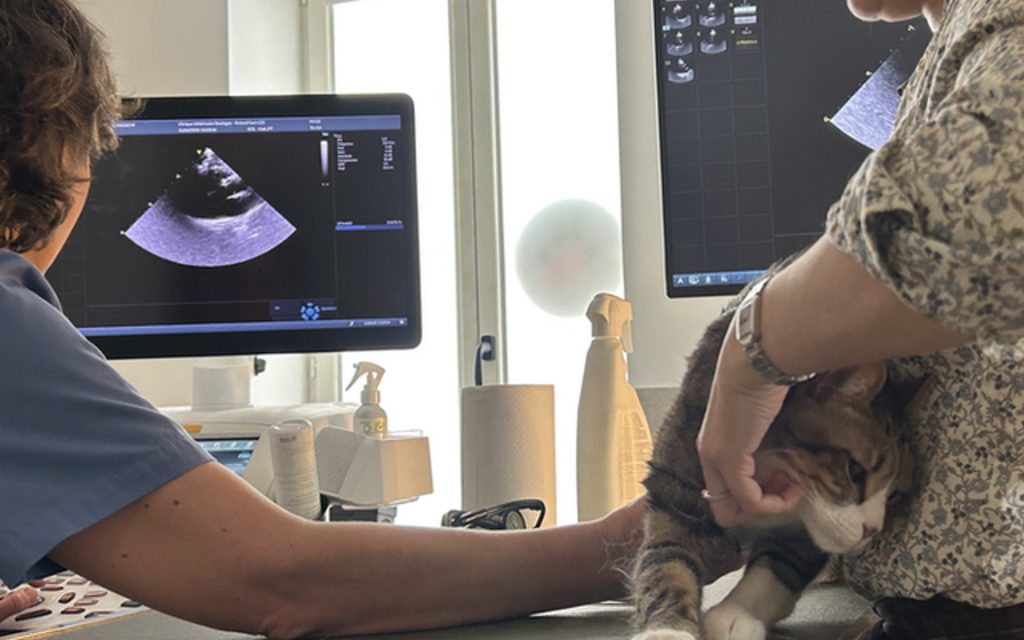
heart scan by vet sonographer Charlotte Renard

When a murmur is detected prior to anesthesia, echocardiography plays a key role in risk assessment and anesthetic planning.

It helps to:

• Confirm whether anesthesia can proceed safely
• Identify patients requiring protocol adjustment
• Reduce peri-anesthetic cardiac risk

This is particularly important in geriatric patients or those undergoing major procedures.

What Your Vet Clinic Receives ?

After each murmur exploration study, your clinic will receive:

✔ A cardiologist-validated written report within 48 hours
✔ Diagnostic interpretation
✔ Assessment of clinical significance
✔ Severity grading if applicable
✔ Recommendations for monitoring or treatment
✔ Guidance regarding anesthetic risk when relevant

How It Works ?

Appointment Scheduling

If your regular veterinarian feels that a cardiac ultrasound (echocardiogram) is needed for your pet, they will contact Mobile Pet Echo directly to schedule the exam.

This ensures:
-The exam is truly indicated
- Coordination between your veterinarian and our service
- A smooth and simple process for you as a pet owner

You do not need to contact a referral hospital yourself

Heart scan at Your Regular Clinic

The echocardiogram is performed directly at your usual veterinary clinic.

This means:
- No long-distance travel
- A faster appointment
- A familiar and reassuring environment for your dog or cat
- Less stress for both the pet and the owner
In most cases, the exam is performed without sedation and takes about 20–30 minutes.

Fast & Reliable Results

The ultrasound images are reviewed by a Board-Certified Veterinary Cardiologist, and a validated report is delivered within 48 hours.


Your veterinarian then:
- Explains the results to you
- Discusses what the murmur means for your pet
- Chooses the best monitoring or treatment plan, if needed
- Clear answers allow confident decisions and peace of mind.

Our Services

Accurate diagnosis when it matters most !

    • EXPLORATION OF A HEART MURMUR

      EXPLORATION OF A HEART MURMUR

      Understanding a detected murmur in an otherwise healthy patient
      • Murmur detected during routine exam
      • Puppies and kittens (innocent vs congenital)
      • Adult or senior patients
      • Pre-anesthetic cardiac assessment

    • DIAGNOSIS OF HEART FAILURE

      DIAGNOSIS OF HEART FAILURE

      When a dog or cat presents with signs of congestive heart failure (CHF), rapid and accurate diagnosis of the underlying heart disease is essential.
      Mobile Pet Echo provides in-clinic echocardiography to help your veterinary team understand why heart failure has developed and how best to manage it.
    • SCREENING FOR HEREDITARY/DISEASE-PREDISPOSED CARDIAC CONDITIONS

      SCREENING FOR HEREDITARY/DISEASE-PREDISPOSED CARDIAC CONDITIONS

      Certain dog and cat breeds are genetically predisposed to specific cardiac disorders. Early detection – even before clinical signs develop – allows for timely management and improved long-term outcomes.